

A moving-day delay calls for a clear update and a practical next step. If your JAS Removals & Storage team hasn’t finished as scheduled, contact the move coordinator, ask what remains and when the crew expects to finish, and keep essential items accessible while you record the delay.
It’s unsettling when your belongings are in transit and the plan changes. A calm, specific update can help you decide what to do next, whether you’re moving home or coordinating a business relocation.
This guide explains how to respond to a delayed move, what information to record, and how to organize the next steps. It also covers what relocation services may include, how move estimates are shaped, and what to look for in a company’s approach to planning and protecting belongings.
Key Takeaways
- If moving-day completion is delayed, get a clear update on what remains and the expected next step, then keep a written record of key details.
- Compare local, long-distance, and international moves by the route, shipment needs, and coordination involved, not distance alone.
- Understand how the move’s size, access, services, and timing shape an estimate, and review what the estimate covers.
- Plan furniture disassembly and reassembly around item construction, safe handling, and the arrangements agreed for the move.
- Match the service to the move: domestic relocation for household moves, office moves for business relocations, and secure storage when belongings need a place between stages.
Local and long-distance relocations
Even a short local move involves access planning. A third-floor apartment with a narrow stairwell needs different coordination from a ground-floor home with driveway access. Before moving day, record building access, parking arrangements, elevator reservations, and restricted delivery windows. Sharing these details early with a Continental Moving Company helps the crew plan loading and unloading at both addresses.
Long-distance moves add route planning and delivery coordination. For a move from one state to another, the destination address, collection timing, route, and delivery expectations all affect the schedule. Confirm who will provide updates and how changes will be communicated. If completion is delayed, ask what remains, request an updated delivery estimate, and note the time and details of each update.
Local and interstate moves are not interchangeable terms. A local move usually stays within the same area, while an interstate move crosses a state boundary. The route matters, as do the household contents, access at both addresses, and the time needed for loading and unloading. A move across town may involve different access constraints from a move across state lines.
Prepare a practical move-day record before the crew arrives. Keep the inventory, destination details, and agreed schedule together in a folder or phone note. If a delay develops, use that record to clarify what has been loaded, what remains, and the status of the next delivery step. For a long-distance move, a Continental Moving Company’s schedule should account for collection, transit, and delivery coordination.
- Before loading: Identify fragile, bulky, or high-priority items, and point them out during the walkthrough.
- At collection: Confirm the destination address and the best contact for schedule updates.
- If timing changes: Ask which part of the move is delayed and what happens next.
- At delivery: Match arriving items against your inventory and note visible damage promptly.
A change of state can affect how you organize essentials. Keep medications, work equipment, chargers, important documents, and a change of clothes separate from packed belongings. For a family relocating from Boston to Atlanta, having school records and everyday necessities accessible can make the first evening more manageable if the shipment arrives later than expected.
Choose a moving plan that reflects the whole route, not just the distance between addresses. A short move with difficult building access may need careful sequencing, while a longer journey calls for clear communication about collection and delivery. Understanding the difference helps you respond calmly, ask focused questions, and keep the move progressing one step at a time.
Moving estimates and pricing
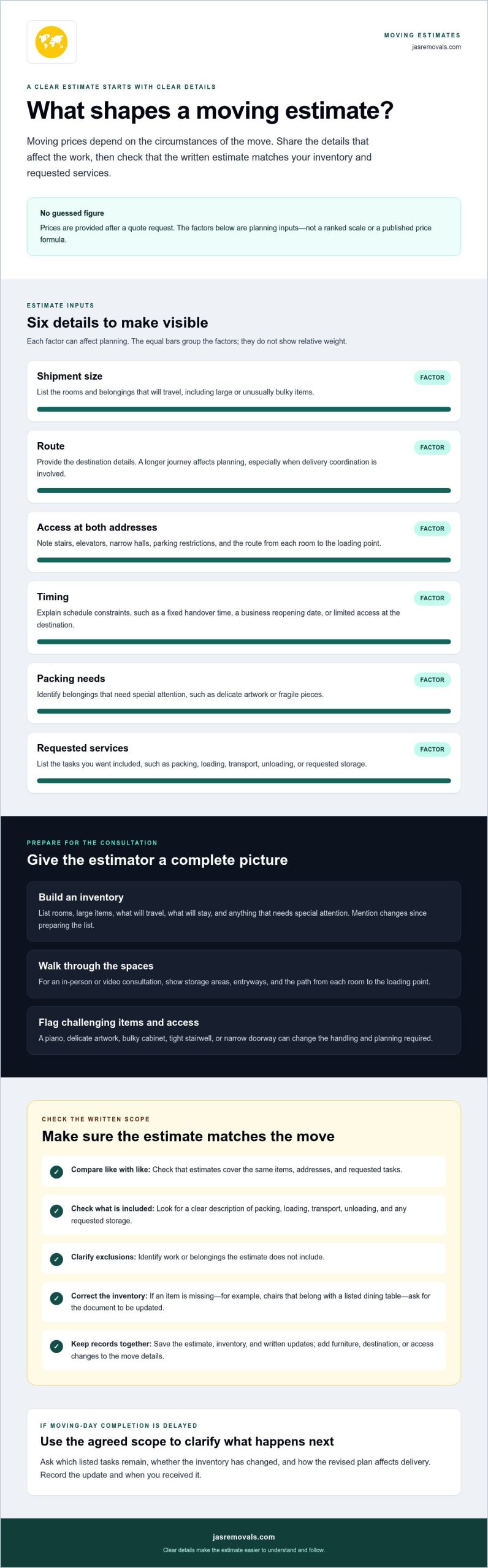
A useful estimate starts with the details of the move, not a guessed figure. Before a consultation, list the rooms, large items, and destination details. Include access notes such as stairs, elevators, narrow halls, and parking restrictions. A sofa that must pass through a tight stairwell, for example, may need different handling from one moved through wide doors. Complete information helps the estimator understand the work involved.
During a consultation, go through the home or office room by room. Identify what will travel, what will stay, and which items need special attention. A piano, delicate artwork, or unusually bulky cabinet can affect planning. For a video consultation, show storage areas, entryways, and the route from each room to the loading point. Mention any changes since preparing the inventory.
Moving prices depend on the circumstances and are provided after a quote request. Factors include shipment size, route, access at both addresses, timing, packing needs, and requested services. A compact apartment move with clear access differs from a larger household relocation involving stairs and fragile pieces. The route also affects planning, especially when delivery involves a long journey.
Read the estimate alongside your inventory and planned services. Look for a clear description of what the move includes, such as packing, loading, transport, unloading, and any requested storage. If the inventory lists a dining table but leaves out its matching chairs, ask for the document to be corrected before accepting the scope. Keep the revised version with your move records.
- Compare like with like: Check that each estimate covers the same items, addresses, and requested tasks.
- Clarify exclusions: Identify work or belongings the estimate doesn’t include.
- Record changes: Add new furniture, destination changes, or access updates to the move details.
- Keep the paperwork: Save the estimate, inventory, and written updates together.
If completion is delayed on moving day, refer to the agreed scope. Ask which listed tasks remain, whether the inventory has changed, and how the revised plan affects delivery. Record the update and when you received it. This gives you a clear account of the change and helps distinguish unfinished work from items outside the original plan.
Use the consultation to discuss practical details, not just the contents of each room. Explain whether your move has a fixed handover time, a business reopening date, or limited access at the destination. These constraints help shape the schedule and estimate around your needs. Accurate details from the start make the resulting plan easier to understand and follow.
Furniture disassembly and reassembly
A bed frame, dining table, or sectional sofa may need partial disassembly to fit through a doorway. Decide which pieces need attention during the pre-move walkthrough. Record each item and clarify who will take it apart, protect loose components, and reassemble it. This helps prevent a large item becoming an unexpected task during loading or delivery.
Before disassembly, photograph each assembled piece of furniture from several angles. Take close-ups of unusual brackets, cable connections, and adjustable fittings. Put screws and small hardware in labeled bags, then secure each bag to its matching item. For a desk with several drawers, label each drawer and note its original position. Keep assembly instructions with the parts, if available.
Some furniture is designed for repeated assembly; other pieces are more delicate. A flat-pack bookcase, antique cabinet, and adjustable bed base each have different construction. Check the manufacturer’s instructions for lifting points and removable components. Don’t force a stuck fitting or remove structural parts without understanding their purpose. Identify any fragile or unusually valuable pieces before finalizing the move plan.
- List the item: Name each piece, such as a king bed frame or corner desk.
- Note the task: Record whether it needs disassembly, reassembly, or both.
- Keep parts together: Label hardware bags and attach them securely to the matching item.
- Protect surfaces: Separate removable shelves and wrap them to prevent rubbing or impact.
At delivery, check each item before reassembly begins. Compare the parts with your photographs and inventory. Confirm that screws, brackets, shelves, and support rails are present. If a component is missing, record the item and missing part before continuing. This is especially useful for a modular wardrobe, where similar panels can be hard to tell apart once unpacked.
A delayed completion can complicate furniture setup if a bed or dining table is still in pieces. Ask which items have been disassembled, where their hardware is stored, and what work remains. Keep essentials accessible, such as a mattress, bedding, and a chair. If assembly is outside the agreed move scope, plan how to handle it without interrupting other delivery work.
Clear preparation helps protect furniture and keep the schedule organized. Share the item list, photos, and any manufacturer instructions before moving day. At the destination, choose a clear assembly area with enough space for panels and tools. A labeled box for each item’s hardware, paired with a photo of its original setup, makes the next steps easier to follow.
International moving
An international relocation involves more handoffs than a move within one country. It includes collection, export preparation, international transport, destination handling, and delivery. Each stage needs clear ownership and timing. Ask for the planned sequence and the contact responsible for communicating updates at each handoff.
Start with a room-by-room inventory. Describe items clearly, including quantity, condition, and whether they need special packing. “Two framed oil paintings” is more useful than “art,” while “solid wood dining table with six chairs” gives a clearer picture of the shipment. Keep a copy of the inventory and photograph valuable or delicate belongings before packing.
Organize destination paperwork and shipment details before collection. Requirements depend on the destination and the contents being moved, so keep personal records, item descriptions, and moving documents together. Separate documents from packed household goods and keep them accessible during travel. Clear, consistent descriptions can help avoid confusion between the paperwork and the shipment.
Choose packing based on the route and each item’s fragility. A framed mirror needs different protection from a box of books, and a piano requires careful planning for its size and construction. Identify delicate pieces while preparing the inventory. Keep essential items, such as medication, chargers, and work documents, with you rather than inside the shipment.
- Before collection: Confirm the origin and destination addresses, inventory, and collection plan.
- At dispatch: Record which items are packed and note any changes to the shipment.
- During a delay: Ask which stage is affected, what remains, and when the next update will arrive.
- At delivery: Compare delivered items with the inventory and note visible damage.
International delays can happen at different stages, so identify where the shipment is before making new arrangements. If collection is complete but delivery timing changes, ask whether it is awaiting transport, destination handling, or final delivery. Record the update, who provided it, and any revised arrangements. This creates a useful timeline and keeps each handoff clear.
Plan the first days at your destination around belongings that travel separately. A family moving from Sydney to Vancouver might keep children’s school materials and daily essentials in accessible luggage. For furniture, note any pieces that need careful handling or later assembly. A written list of those priorities helps everyone understand what matters most when the shipment arrives.
Before confirming an international move, review the route, inventory, packing plan, and communication process together. Make sure the origin and destination details match across your records. If a delay changes collection or delivery arrangements, use that shared information to ask focused questions and understand the next step.
Residential and commercial moving
A household move and an office relocation have different priorities. A family moving from a two-bedroom home may focus on beds, kitchenware, and school supplies. A business moving a design studio must also consider equipment, records, and the planned return to work. In both cases, list essential items and identify which spaces need to be usable first.
For a home move, group belongings by room and note any access constraints. A crib, refrigerator, or sofa may need priority at delivery because it supports daily routines. Keep medications, personal documents, chargers, and a change of clothes accessible. If completion is delayed, you can manage immediate needs without searching through packed boxes.
Commercial relocations need a sequence that supports business continuity. For a small office, identify workstations, shared equipment, storage, and items that must remain secure. Assign a named contact to coordinate access and communicate schedule updates. Before the move, label boxes by team or destination room. A box marked “Finance, records” is easier to place correctly than one marked only “Office.”
When moving-day work falls behind, clarify the impact on each setting. A household may need to know whether beds will arrive that evening. A business may need to know whether computers and desks will be ready before staff return. Ask what remains, which areas are affected, and what the next update will cover. Record the response, when you received it, and who provided it.
- Set priorities: Mark essential household items or business equipment for early access.
- Label clearly: Use room names at home and team or department names at work.
- Protect sensitive items: Keep personal documents or confidential business records under clear control.
- Plan access: Share building entry instructions, loading areas, and destination room details.
At home, check that delivered furniture reaches the intended rooms before unpacking begins. At an office, compare equipment and labeled cartons with the move inventory. If a desk arrives without its chair, or a workstation is missing a monitor, note the gap and report it through the agreed contact. Specific item descriptions help resolve confusion more quickly than a general report of missing belongings.
A move plan should reflect the people who depend on the space. For a household, that may mean setting up a child’s bedroom before less-used rooms. For a business, it may mean placing reception equipment and essential workstations first. Share those priorities before loading, then use them to assess progress if completion is delayed. Clear sequencing helps everyone focus on the next practical task.
JAS Removals & Storage: International Moves
JAS Removals & Storage coordinates international moves, from planning the household shipment to managing its next stages. Turn to the team when preparing to move across borders and you need a clear plan for your belongings, collection, and delivery. Sharing your inventory, origin and destination details, access notes, and priority items helps shape the move around your circumstances.
For a move within the country, Household Moves support residential relocation. Businesses planning a site change can use Commercial Moves, while Storage can help when belongings need to be held between stages. The right arrangement depends on the type of move and the space or timing involved.
Contact JAS Removals & Storage to discuss your relocation and agree on a practical next step.
Set Up the Next Move with Clarity
A delay can unsettle the day, but it need not dictate every decision that follows. Keep the next step practical: clarify what remains, preserve a written record, and set aside essentials while plans adjust. For future moves, treat clear communication and expectations as part of the logistics, not as details to leave until moving day. A Continental Moving Company should explain the planned scope and how updates will be handled, so you can make decisions with a clearer picture.
JAS Removals & Storage supports international and domestic relocations, as well as commercial moves. If you’re planning a move or need to discuss the next stage, contact the team and share the details that matter to your circumstances.
Contact JAS Removals & Storage to take the next step with a considered plan. A clear conversation can help you move forward with greater confidence.