

What if the first step in an international move isn’t choosing a shipping date, but working out which decisions depend on others? Knowing how to plan an international move means setting the sequence early: destination requirements can shape what you take, while housing and shipment timing affect what you’ll need when you arrive.
It’s understandable to feel unsure where to begin. Documents, import requirements, packing, housing, and travel dates all need attention, and a change in one plan can affect the rest. A clear order makes the work easier to manage and shows where timing may need flexibility.
This guide lays out a practical sequence, from confirming your destination plans and researching official entry and customs guidance to organizing belongings, coordinating shipment, and preparing for arrival. You’ll also learn how to plan for the gap between moving out and moving in, including when secure storage or professional coordination can help keep arrangements connected.
Key Takeaways
- Learn how to plan an international move by working backward from your intended arrival date and grouping tasks by stage.
- Separate immigration and entry questions from household-goods import requirements, then use official government sources for destination-specific guidance.
- Decide what to ship, keep, store, or dispose of based on your destination home and the timing of your move.
- Allow for a gap between leaving one home and accessing the next, and consider how storage could fit into the plan.
- Connect packing, overseas shipping coordination, and storage to keep the practical parts of your relocation aligned.
How to plan an international move by putting decisions in the right order
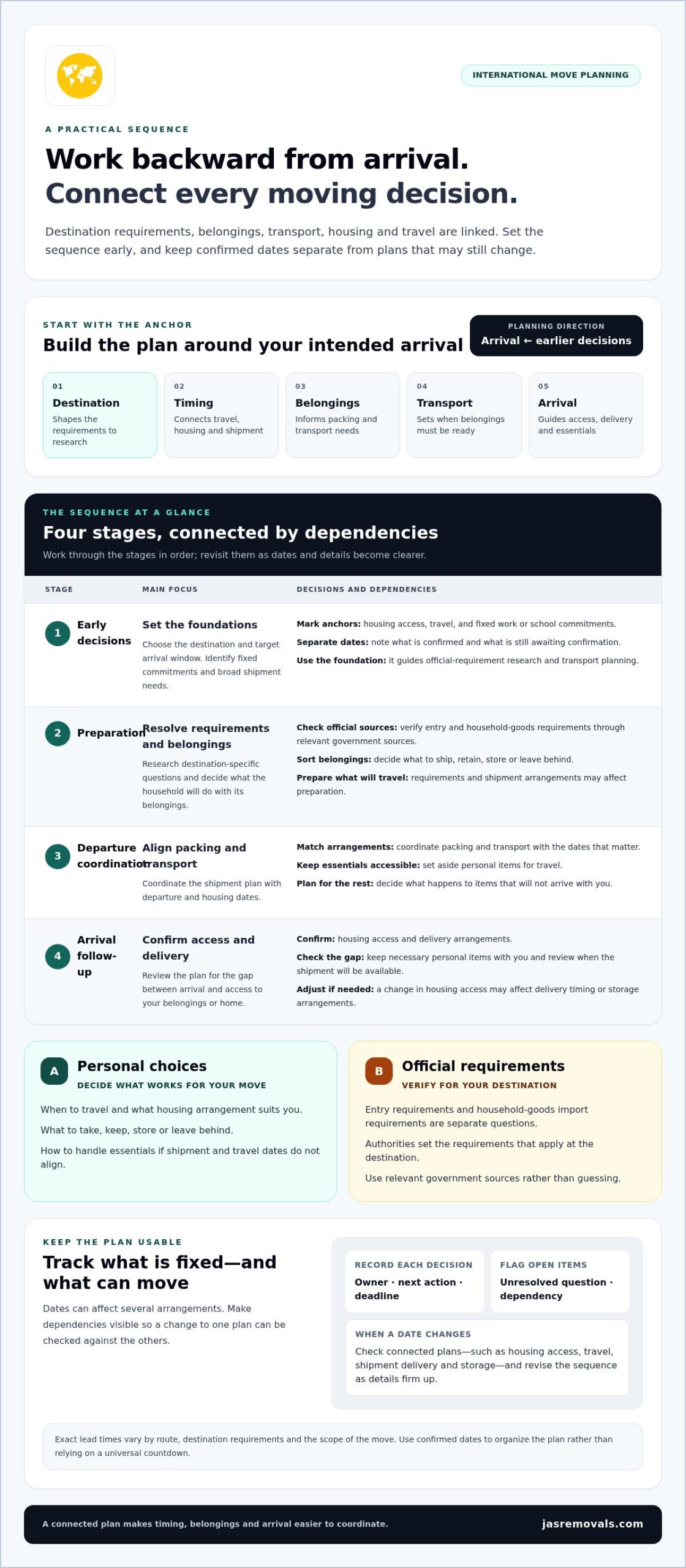
Planning an international move means connecting five practical elements: destination, timing, belongings, transport, and arrival. Uncertainty often comes not from a lack of effort, but from trying to settle these linked decisions separately. The destination shapes what you need to learn about entry and household goods. Your intended arrival date affects travel, shipment, and housing. The belongings you take influence packing and transport arrangements.
To understand how to plan an international move, follow the dependencies rather than treating every task as equally urgent. This guide moves from establishing the relocation to mapping dependencies, preparing, coordinating, and reviewing the plan as dates or circumstances change. It offers a practical planning framework, not a substitute for destination-specific official guidance. For a broad foundation, see this overview of understanding relocation in an international context.
What makes an international move different from a local move?
A cross-border move adds destination requirements and a longer logistics chain. You can decide when to travel, what to take, and what housing arrangement suits you, but authorities set the entry and import requirements that apply at the destination. Keep the two kinds of decisions distinct: personal preferences belong in your plan, while official requirements need to be checked through relevant government sources.
Dates are connected, too. If your new home won’t be ready when you arrive, you may need temporary accommodation or storage. If shipment and travel dates don’t align, plan how you’ll access essentials during the gap. A change to one date can affect several arrangements, so record which choices are fixed and which can still move.
Which decisions should come first?
Begin with the foundations: destination, intended move window, household size, and broad shipment needs. These give you a working picture before you make detailed packing or transport decisions. Then identify fixed dates, such as a work start, school term, lease end, or confirmed housing access. Treat them as planning anchors, while leaving flexibility around dates that are not yet settled.
A move plan is a sequence of linked decisions: destination requirements shape what can travel, household size informs shipment needs, and arrival and housing dates guide transport timing and any storage arrangements.
Write down each anchor date, then add the decisions that depend on it. For example, if you know when you must leave your current home but not when you can access the destination property, mark housing access as unresolved and consider how that gap could affect delivery. That makes a dependency visible before it becomes a last-minute scramble.
- Establish the destination and intended move window.
- Note fixed commitments and identify dates still awaiting confirmation.
- Estimate what the household expects to take and what support that may require.
- Connect housing, travel, shipment, and arrival arrangements, revisiting the sequence as details firm up.
Once these starting points are clear, turn them into a timeline, pacing preparation and coordination around the dates that matter most.
Build an international moving timeline around key dependencies
A useful timeline starts with the destination, not a pile of tasks. Choose your intended arrival date as the planning anchor, then work backward to see what needs to happen first. The sequence matters: transport arrangements shape when belongings need to be ready, and those arrangements may depend on destination requirements and a clearer idea of what you’re taking.
How do you work backward from an arrival date?
First, mark known dates, including housing access, travel, and fixed commitments such as a work or school start. Then add the decisions and arrangements that must be settled before each date. Leave flexibility around dependencies outside your control, such as official processing or changes to housing access. Exact lead times vary by route, destination requirements, and the scope of the move, so use this framework to organize your confirmed dates rather than relying on a universal countdown.
- Early decisions: Set the destination and target arrival window, identify fixed commitments, and define the broad shipment need. These choices give you a basis for researching official requirements and organizing transport. Detailed packing decisions can wait until you know what will travel.
- Preparation: Resolve destination-specific questions, decide which belongings to ship, retain, store, or leave behind, and prepare the items you intend to move. Household-goods requirements and shipment arrangements may affect how you prepare.
- Departure coordination: Align packing and transport arrangements with your departure and housing dates. Once the shipment plan is clear, set aside essentials for travel and decide what will happen to items that won’t arrive with you.
- Arrival follow-up: Confirm your access and delivery plans, keep necessary personal items with you, and review any gap between arrival and shipment. A change in housing access may mean adjusting delivery timing or arranging storage.
How should you keep the plan usable?
Keep one shared planning record with each major decision, its owner, next action, deadline, and any unresolved question. Separate confirmed dates from estimates, and note which tasks depend on an answer or arrangement still in progress. If a housing date shifts, you can quickly identify whether travel, delivery, or storage needs attention too.
For example, if the travel date is fixed but housing access is uncertain, keep the arrival plan moving while flagging delivery as dependent on access. Revisit that dependency when the housing date becomes clearer instead of treating the whole timeline as stalled. This practical approach to how to plan an international move keeps progress visible while allowing room for change.
Once the timeline is mapped, explore JAS international moving support to coordinate packing, overseas transport, and storage around your move dates.
Prepare destination documents and requirements without guessing
Keep two kinds of destination research separate. Immigration and personal-entry requirements concern whether you and your household can enter, reside, or work at the destination. Household-goods import and shipping requirements concern what may travel with you and what information or documents the shipment may need. These can involve different authorities, deadlines, and supporting documents, so treating them as one general paperwork task can obscure what needs attention.
Requirements vary by destination and personal circumstances. Don’t assume that a rule you’ve heard about applies to your situation or that a general moving guide answers questions about eligibility. Use relevant official government sources for current information, and record what each source says alongside the action it requires. This keeps administrative decisions distinct from the transport plan while showing where they affect shipment preparation.
Which destination questions belong on the planning record?
Organize questions by subject and identify the authority responsible for the answer. For each item, note the source, the date you checked it, the next action, the person responsible, and any deadline or document dependency. If an answer is unclear or depends on your circumstances, mark it as unresolved rather than treating an assumption as confirmed.
- Entry and residence: What permission may be needed to enter or reside, and what steps apply to your household’s circumstances?
- Work: Are there separate entry or documentation questions linked to your intended work arrangements?
- Identity documents: Which travel or identity documents should each household member prepare, and are any additional documents relevant?
- Household goods: What rules or declarations apply to the personal belongings you intend to ship?
- Vehicles, pets, or restricted items: If relevant to your move, which official source explains their import requirements and any related steps?
Flag questions that depend on another document or decision. For example, if a shipment declaration relies on an inventory, note that connection and assign someone to prepare or review the inventory. If an application or document has a stated deadline, record it as a dated action rather than burying it in general notes.
How can you avoid relying on outdated information?
Start with the destination’s official immigration or foreign-affairs authority for entry, residence, and work questions. For household goods and other imports, look to the government department responsible for customs or border controls. An embassy or consulate may also direct you to official information relevant to your circumstances. Informal summaries can help you identify questions, but they shouldn’t replace current government guidance on rules or eligibility.
Recheck the source if your travel date, household circumstances, or shipment plans change. Keep the date you reviewed each requirement so you can see what may need another look. Destination requirements must be verified with the relevant authority, because rules and the documents they require depend on the destination and your circumstances.
A clear record supports the wider sequence of how to plan an international move: it shows which questions are answered, what remains open, and which preparation or shipping decisions depend on official guidance.
Coordinate belongings, shipment, and arrival as one moving plan
Your belongings, transport arrangements, and destination home need to meet at the right point in the move. Start by deciding what you expect to take, then connect that choice to the shipment plan and the date you can receive items. An inventory can support these decisions: it gives you a shared record of what is intended to travel, what needs special attention, and what may need another arrangement. It doesn’t replace official guidance on import eligibility.
How should you decide what travels with you?
Sort items by how you’ll use them, whether they suit your destination home, and whether their size or nature calls for specialist handling. Keep valuable, delicate, oversized, piano, or fine-art items visible in the inventory so they can be considered in packing and transport planning. For questions about whether an item may enter the destination, use the relevant official source rather than relying on a general moving checklist.
| Decision | Practical planning question |
|---|---|
| Ship | Will you need or use this item at the destination, and can it be included in the shipment plan? |
| Retain | Do you need it during travel or before the shipment arrives? Keep essentials accessible rather than packing them with items you won’t have on arrival. |
| Store | Do you want to keep the item but can’t send or receive it at the same time as the rest of your belongings? |
| Dispose | Is it useful to carry forward, or would leaving it out simplify the move? |
Keep the inventory practical. Record enough detail to distinguish items and group them by their intended plan, such as shipment, storage, or personal use. This makes it easier to discuss packing and handling, and to spot when a change in housing or delivery timing affects a particular group of belongings. In how to plan an international move, an inventory is most useful as a coordination tool, not an end in itself.
What if your home and shipment dates do not align?
A gap between arrival and access to your home, or between moving out and delivery, calls for a separate transition plan. Map where you’ll stay, which essentials you’ll need close at hand, and when the shipment can be delivered. Keep these dates connected: if access changes, the delivery plan may need to change too.
Some belongings may need to wait, even if you’re ready to leave. Secure short-term or long-term storage can help bridge that timing gap, keeping the shipment plan aligned with your housing situation rather than forcing every item onto the same schedule. JAS Removals & Storage coordinates international relocation, tailored packing, overseas shipping, and secure storage as connected parts of the move.
To align belongings, transport, and a timing gap, plan your international move with coordinated packing and storage.
Make international moving easier with coordinated relocation support
A clear plan gives each task a place. Coordinated support can connect the parts that still need to work together: preparing belongings, arranging overseas transport, and accounting for a gap between departure and delivery. This matters when one change affects another, such as housing access shifting after shipment plans are underway.
Professional coordination doesn’t replace your decisions about destination requirements or personal documents. It helps organize the moving parts around them, so packing, transport, and storage reflect the plan you’ve developed. That’s one practical way to make how to plan an international move feel more manageable: keep responsibilities clear and connect each handoff to the dates and information it depends on.
How can coordinated support reduce handoff complexity?
Packing, transport coordination, and storage work best as related parts of the same relocation plan. Tailored packing prepares belongings for shipment, while overseas logistics coordination links transport arrangements to the move schedule. If you can’t receive everything at once, secure short-term or long-term storage can be part of the plan, rather than leaving belongings and delivery timing to be managed separately.
Clear communication keeps those handoffs visible. Share inventory updates, changes to departure or housing dates, and delivery arrangements that may affect the sequence. This lets the moving plan respond to revised details without losing track of what needs attention. For a piano or fine art, specialist export packing can address those items within the wider relocation. For a business move, IT de-commissioning and re-commissioning may also need to be considered alongside the office move schedule.
What details help begin a moving conversation?
You don’t need every decision finalized before discussing the move. A useful starting picture includes your origin and destination, preferred dates or date range, the household’s general scope, and any belongings that need special handling. It also helps to explain known constraints, such as a fixed departure date, a gap before housing access, or items that may need storage.
These details help shape a tailored plan around the move’s practical requirements, including packing, overseas shipping coordination, and storage where needed. If some information is still open, identify it as an unresolved question so it can be considered in context rather than mistaken for a confirmed arrangement. Keep destination-specific entry and import questions directed to the relevant official authorities; moving coordination supports the logistics, not the interpretation of those requirements.
When you’re ready, discuss your international move with JAS. Share the details you have to begin with a practical view of your relocation needs.
Take the next step with a plan that can adapt
A move plan doesn’t need to predict every detail. It needs to give you a steady reference point, so when a date or decision changes, you can see what else may be affected and adjust with care. That’s the practical value of understanding how to plan an international move: you’re not aiming for perfect certainty, but for a considered way forward.
Use your current plan to identify the next decision that needs attention and the information still outstanding. Then bring the moving arrangements into focus with a conversation tailored to your circumstances. JAS Removals & Storage can help connect the practical details of your relocation and give your next steps a clear starting point.
Talk through your relocation plans with JAS. One step at a time, you can move forward with greater clarity and confidence.
Frequently Asked Questions
When should I start planning an international move?
Start as soon as you have a likely destination and a target move window, even if some details are tentative. Early planning gives you time to identify questions that could affect later arrangements, such as entry documents or what can travel with your shipment. You don’t need every answer before beginning. Record what’s known, what’s uncertain, and when you’ll revisit open decisions as your plans firm up.
What should I plan first when moving to another country?
Begin with the destination, your intended arrival period, and the household’s main commitments, such as a job start or school enrollment. These details help you identify which official requirements apply to your circumstances and which dates are fixed. To understand how to plan an international move, think of the first stage as setting boundaries: what must happen, what can change, and what information you need before making dependent arrangements.
Do I need a visa before shipping my household belongings?
There isn’t one answer that applies to every destination and personal situation. Entry permission and household-goods import procedures are separate questions, and the timing or documents involved can differ. Check the relevant government immigration and customs sources for your destination before relying on assumptions about whether goods can be shipped or cleared. Keep the shipment question open in your planning record until you’ve verified the applicable requirements and document dependencies.
What happens if my belongings arrive before I can move into my new home?
If you can’t access your home when your belongings are ready for delivery, you’ll need an interim plan for both the shipment and your immediate needs. Coordinate delivery timing with your confirmed access date, and keep travel essentials with you rather than packed away. If the dates remain apart, secure storage can hold belongings until delivery is workable while you arrange temporary accommodation.
Can I store some belongings during an international move?
Yes. Storage can be useful if you’re keeping items but can’t send them with the main shipment or receive them at your destination yet. Separate the items you want stored from those intended for shipment, and note when each group may be needed. JAS Removals & Storage provides secure storage for short-term or long-term needs, which can be coordinated with the wider relocation plan.
How do I keep track of international moving documents?
Use one shared digital or paper record, with a separate entry for each document or requirement. Include the official source, date checked, action required, deadline, responsible person, and current status. Save copies in clearly named folders, such as “identity,” “entry,” and “shipment,” so household members can find the right material without searching unrelated files. Keep originals secure and note who is carrying them during travel.
What should I do if my international moving dates change?
Update the shared plan as soon as a date shifts, then trace what depends on it. A later home-access date, for example, may affect delivery arrangements, temporary accommodation, or storage needs. Review travel commitments and any deadlines tied to official documents, checking current government guidance if your circumstances have changed. Share relevant schedule updates with the people coordinating your move so transport and delivery plans can be adjusted together.