

The smoothest international move isn’t defined by a confident promise. It depends on clear coordination from collection to delivery. If you’re wondering how to choose international movers, look beyond reviews and headline claims. Find out what the service covers, who coordinates each stage, how handoffs are managed, and whether the packing and transport arrangements suit your belongings and timing.
Overseas moves involve more than getting belongings from one country to another. A service description may not make every step or responsibility clear, so compare the scope of support, how logistics are coordinated, and how the plan accounts for your shipment.
This practical 2026 guide explains what to compare, how common service needs differ, and what to prepare before discussing your relocation. Use the route, preferred dates, approximate volume, and any items needing specialist handling to make the conversation more specific. With those details in hand, you can assess what support your move requires and how it will be coordinated.
Key Takeaways
- Outline your route, approximate volume, timing, and any belongings that need specialist handling.
- Use how to choose international movers as a practical comparison: assess service scope and how overseas transport stages are coordinated.
- Consider reputation alongside clear explanations of responsibilities and communication throughout the move.
- Prepare a belongings list and a concise summary of your route and timing to support a useful estimate discussion.
- Consider how tailored packing, transport management, and storage could support your international move.
How to Choose International Movers: Start with the Move You Need
Choosing support for a move across borders can feel uncertain because a service that suits one household may not fit another. Your route, the amount being moved, your timing, and any items needing special handling all affect the support and coordination required. Start with the details of your move, not a general promise about what an international move should look like.
An international mover coordinates relocation services and transport so belongings can move between countries through the stages your move requires. You don’t need to plan every task before comparing services. An international moving checklist can help organize the wider move. For an initial discussion about moving support, focus on the shipment and the needs that shape it.
Define the scope of your international move
Write down where belongings will be collected, their destination, your approximate move timing, and the size of the move, such as a studio, family home, or larger household. You don’t need a final inventory yet. A realistic outline gives a clearer starting point than a destination alone and helps show whether the move is compact or includes more complex handling needs.
Make a separate note of belongings that may need specialist attention, such as a piano, fine art, or other delicate, high-value, or oversized items. Also distinguish household requirements from office relocation needs. A household move may center on personal effects and furniture, while an office move can involve workplace contents and IT re-commissioning or de-commissioning. Naming the type of move early keeps the discussion focused.
Identify the support that matters most
Consider where coordination would make the greatest difference. You may need help bringing overseas shipping and logistics together, tailored packing for particular belongings, transport management across move stages, or storage if the timing between homes doesn’t line up. These are options to weigh against your own move, not a universal checklist.
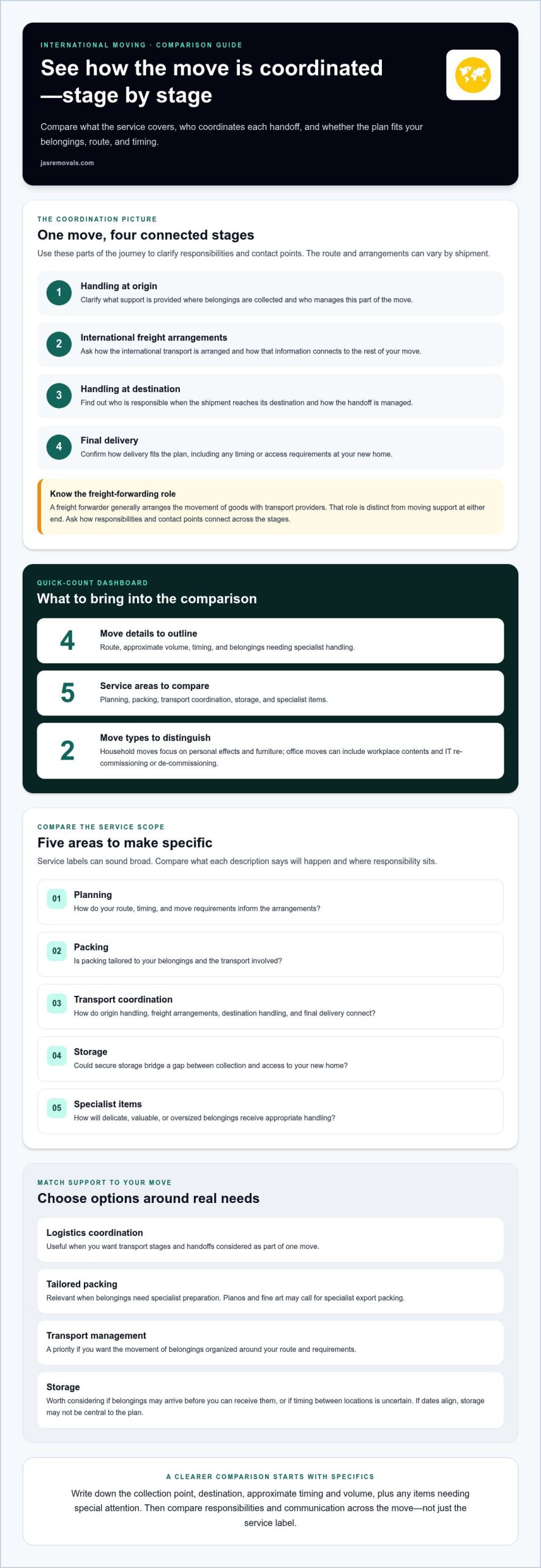
- Logistics coordination: useful when you want the transport stages and handoffs considered as part of one move.
- Tailored packing: relevant when particular belongings need specialist preparation, including pianos or fine art.
- Transport management: a priority when you want the movement of belongings organized around your route and requirements.
- Storage: worth considering if belongings may arrive before you can receive them, or if the timing between locations is uncertain.
For example, if your departure date is firm but access to your new home is still taking shape, short-term transit storage may help bridge the gap. If your dates align, storage may not be central to your plan. Match the service scope to your belongings, route, and timing. Once you can describe those clearly, you have a steadier basis for deciding how to choose international movers and what coordinated support means for your relocation.
Compare International Movers by Service Scope and Coordination
Service labels can sound comprehensive while leaving practical responsibilities unclear. Compare what each description says will happen, who coordinates each stage, and how information is carried across handoffs. International shipments may involve several stages and parties, but the route and arrangements vary. A clear explanation should make those moving parts understandable without suggesting every shipment follows the same pattern.
Understand who coordinates each stage
Consider the journey in parts: handling at origin, international freight arrangements, handling at destination, and final delivery. A freight forwarder generally arranges the movement of goods with transport providers. Its role is distinct from the moving support provided at either end. Some moves involve separate companies at different stages. The useful comparison is whether responsibilities and contact points connect into a coherent plan.
Clear responsibility across shipment stages helps you see who coordinates each handoff and where to turn for information. The International Association of Movers (IAM) represents more than 2,000 companies in the moving and forwarding industry, making it a useful reference for learning about the sector. Reputation signals can add context, but they don’t replace a plain explanation of service scope and communication.
Compare the scope, not the label
Use a simple grid to record what the service description covers and where responsibilities sit. The same service category may be handled differently depending on the route and shipment, so look for specifics rather than assuming a label means the same thing everywhere.
| Service area | What to compare |
|---|---|
| Planning | How route, timing, and move requirements inform the arrangements. |
| Packing | Whether packing is tailored to the belongings and the transport involved. |
| Transport coordination | How origin handling, freight arrangements, destination handling, and final delivery connect. |
| Storage | Whether secure storage can bridge a gap between collection and access to the new home. |
| Specialist items | How delicate, valuable, or oversized belongings receive appropriate handling. |
Match service options to belongings and timing
Packing needs can vary within one household. Tailored packing supports belongings that need additional protection during transport, while pianos and fine art may call for specialist export packing. List these items when comparing services so their handling isn’t lost in a general description of household contents.
Storage can also matter if departure and arrival dates don’t align, or if access to the new home is uncertain. Secure storage may provide a practical bridge, whether the need is short-term transit holding or longer-term storage. It won’t be relevant to every move. Compare each service against your actual requirements.
JAS Removals & Storage coordinates overseas shipping and logistics, with tailored packing and transport management for international moves. Explore international moving support to understand how these services can be shaped around your relocation.
Assess Trust, Communication, and International Moving Experience
A badge, high review score, or broad claim of international expertise can offer context, but none tells the whole story. Trust is easier to assess when reputation signals sit alongside a clear explanation of the service: what is coordinated, how responsibilities connect, and how information is shared as the move progresses. Consider the full picture rather than relying on a single indicator.
JAS Removals & Storage provides international relocation assistance that includes coordination of overseas shipping and logistics, tailored packing, and transport management. As you consider how to choose international movers, look for a clear connection between the support described and the needs of your relocation, rather than relying on promotional language alone.
Read reviews for relevant evidence
Customer feedback is most useful when it describes details that matter to an overseas move. Look for specific comments about communication, care for belongings, and coordination across different stages. A general rating can suggest an overall impression, but it may not show whether the reviewer had a move similar to yours or needed comparable support.
Reviews have limits. One person’s account can’t predict another move, since routes, belongings, and timing differ. Treat feedback as one signal, then consider whether the service description explains the responsibilities and coordination your move requires.
Look for clear, consistent communication
Clear communication makes a complex process easier to follow. Planning details, responsibilities, and shipment stages should be explained in language you can understand. A consistent point of contact can help keep information connected. When several parties are involved, knowing who coordinates a handoff and where updates come from can reduce uncertainty.
Communication is not just frequent contact. It is useful, consistent information that helps you understand what has been arranged, what stage the shipment is at, and where responsibilities sit. A service built around overseas shipping and logistics coordination should make those relationships easier to understand, not leave you piecing together a plan from separate descriptions.
Use reputation signals with care:
- What they can show: reviews and recognition may offer insight into past customer experiences or professional standing.
- What they can’t show alone: a badge or score doesn’t explain the scope of your move, who coordinates each stage, or how communication will work for your circumstances.
That distinction keeps the comparison grounded. Good feedback can support confidence, but clear responsibilities and understandable communication show how a service is organized. JAS’s tailored packing and transport management provide a basis for discussing how support can fit the belongings and coordination needs of an international relocation, while recognizing that each move has its own requirements.
Prepare for a Useful International Moving Estimate
A useful estimate discussion starts with a clear picture of the move. You don’t need every detail settled, but consistent information about the route, belongings, and timing helps shape a project-specific conversation. It also makes it easier to understand what support is being discussed, rather than comparing estimates based on different assumptions.
Organize the details movers need to understand
Gather the known facts first, then note the questions that are still open. This keeps the discussion focused and makes uncertainty visible instead of leaving important details unstated.
- Outline the route. Note the collection location and destination, including any relevant access details that may affect collection or delivery.
- Describe the belongings. Prepare an overview of the household contents and approximate volume. A clear inventory is helpful if you have one, but an initial summary can establish the scale of the move.
- Flag specialist items. Identify belongings such as pianos, fine art, or other delicate, high-value, or oversized items that may need tailored handling.
- Describe the timing. Share your preferred collection window and any known constraints at either end. Note if the dates are still flexible.
- Include possible storage needs. If access to your new home may not align with collection or arrival, mention that secure storage could be relevant.
Separate confirmed details from open questions. For example, you might know the destination and approximate move period but still be waiting to learn when you can access the property. Making that distinction keeps the discussion accurate and gives a clear view of what may shape the plan.
Compare the estimate by what it explains
Read the estimate discussion for scope and coordination, not just a headline figure. Notice whether it describes the support being considered, how transport stages relate to one another, and where responsibilities sit. If estimates are based on different packing or storage assumptions, they may not represent the same service. A clear explanation helps you compare like with like.
An estimate is a project-specific discussion based on the details available; it isn’t a final promise about timing or outcome. If your route, inventory, or dates change, the assumptions behind that discussion may change too. Keep a record of what you shared and what the proposed service covers, so you can revisit open points consistently.
If you’re also weighing a moving service against arranging shipping separately, an international movers versus shipping company comparison can help clarify the difference in scope. For a separate look at budgeting, use an international moving cost guide. Keep that cost research distinct from the service responsibilities being discussed here.
With your route, belongings, specialist items, and timing outlined, you’re ready for a more focused conversation. Discuss your international move with JAS and share the details that will help frame the support your relocation needs.
How JAS Removals & Storage Supports an International Move
A well-coordinated move brings the transport plan and the practical needs of your belongings into the same conversation. JAS Removals & Storage provides international relocation assistance centered on overseas shipping and logistics coordination, supported by tailored packing and transport management. The support is considered in relation to the move, rather than assuming every household needs the same arrangement.
The criteria in this guide can help you describe what matters: the route, the belongings involved, any specialist handling, and how timing between locations may affect the plan. Those details give a clearer starting point for discussing the coordination your relocation calls for and how to choose international movers with greater confidence.
Bring coordination and tailored handling together
Overseas transport involves connected considerations, from preparing belongings for their journey to organizing how they move through the relevant transport stages. JAS’s logistics coordination and transport management bring those considerations into one project discussion. The arrangements depend on the move, so consider how the service scope fits your shipment and what support is important to you.
Packing can also be tailored to the belongings being moved. A household may include everyday contents alongside items that need additional care. Describing those differences makes the packing discussion more specific. Rather than treating packing as a single standard task, identify which belongings need a more considered approach and how that fits with the wider transport plan.
Plan around timing, storage, and specialist belongings
Moving dates and access to a new home don’t always align. If there may be a gap between collection and when you can receive your belongings, JAS offers secure storage for short-term transit holding or longer-term needs. Mentioning the possible gap early keeps storage in view as part of the move’s overall timing, rather than an afterthought.
Some belongings call for more specialized preparation. JAS provides piano and fine art export packing for moves that include these items. Mentioning a piano or artwork when you describe the shipment distinguishes those needs from general household contents and gives the packing and transport discussion useful detail.
- For coordination: describe the route and the transport support you’re looking for.
- For tailored handling: identify belongings that need specialist packing, including pianos or fine art.
- For timing: mention any uncertainty about when your new home will be ready to receive your belongings.
A clear conversation doesn’t require every detail to be settled. Start with what you know, explain what remains uncertain, and discuss how overseas logistics, tailored packing, transport management, and storage relate to your move. Talk through your international relocation with JAS to explore the support that suits your plans.
Take the Next Step Toward a Move Plan
Turn what you know into a clear starting brief: where you’re moving, what needs to travel, when you expect to move, and which details are still taking shape. You don’t need every answer before beginning. A focused conversation can help organize the open questions around your relocation.
Choosing well isn’t about finding a perfect-sounding promise. It’s about understanding how the support fits your circumstances and having a clear basis for planning what comes next. If you’re considering how to choose international movers, bring your priorities forward and discuss how JAS Removals & Storage can shape international relocation assistance around overseas logistics, tailored packing and transport management, storage, or specialist piano and fine art export packing as relevant to your move.
Discuss your international move with JAS Removals & Storage and take the next step with a clearer sense of what your relocation needs.
Frequently Asked Questions
How far in advance should I choose international movers?
Start planning at least 8 to 12 weeks before your intended departure, where possible. That gives you time to compare service scope, discuss your shipment, and prepare the information needed for planning. If your move includes a large household, specialist belongings, or dates that are still changing, begin earlier if you can. A shorter window doesn’t make planning pointless, but it can leave less room to work through details calmly.
What is the difference between an international mover and a freight forwarder?
An international mover focuses on the broader relocation of household or business belongings, while a freight forwarder generally arranges the movement of goods with transport providers. Their roles can overlap within a shipment, and the exact division of work depends on the service arrangement. For example, a mover may coordinate relocation support while freight is arranged through a forwarder. Understanding which party handles each task helps keep responsibilities clear.
Do international movers handle customs clearance?
Some international moving arrangements include customs-related guidance or coordination, but customs clearance shouldn’t be assumed to come with every service. Responsibilities can vary by destination and by the scope of the move. Identify who is responsible for preparing and submitting required shipment information, and what you need to provide. Destination-specific requirements can differ, so use official customs guidance for current rules.
What information should I provide for an international moving estimate?
Share the collection and destination locations, your preferred move period, and a practical overview of what’s being moved. Mention unusually large items, pianos, artwork, or other belongings that may need specialist attention, along with any possible storage need. If details are uncertain, label them as estimates rather than presenting them as final. This is a useful starting point for how to choose international movers and discuss a service scope based on your actual move.
Can international movers store my belongings between homes?
Yes, storage can help if your belongings need to leave one home before you can receive them at the next. For example, a delayed property handover or a temporary stay elsewhere may create a gap between collection and delivery. Consider how storage fits into the overall movement plan and whether you need short-term holding or a longer period. JAS Removals & Storage provides secure storage for transit holding and longer-term needs.
How can I tell whether a moving company is suitable for fragile or valuable items?
Look for a clear explanation of how the items will be identified, packed, and considered within the transport plan. Give practical details, such as an artwork’s approximate dimensions or whether an instrument has delicate components, so the handling discussion is specific. JAS Removals & Storage provides piano and fine art export packing. Describe what makes each item vulnerable, rather than relying on a general description such as “fragile.”
Is an international moving company different from a shipping company?
Yes. A shipping company generally focuses on transporting goods, while an international moving company centers on relocating household or business belongings and may coordinate related packing and transport needs. The distinction matters if you want support beyond the freight leg, such as preparing household contents for transit. Compare the responsibilities in the service description to understand whether it covers a relocation or mainly the shipment itself.