

If a fragile item is damaged during a move, whether repair or compensation applies depends on the move’s coverage and the circumstances of the damage. Choosing movers for fragile items also means understanding how packing, handling, and any special crating will help protect your belongings in transit.
Fragile possessions often carry more than practical value. A chipped heirloom, cracked artwork frame, or damaged piano can be difficult to replace, so preparation matters. The U.S. Environmental Protection Agency recommends that professional packers handle dishes, glassware, china, antiques, and other fragile or valuable articles.
This guide explains how professional packing and specialty materials help protect delicate items, when antiques, pianos, and fine art may need extra handling, and what can affect moving costs. You’ll also learn what to understand about damage coverage and what information can help you make an informed decision before moving day.
Key Takeaways
- Match packing materials and handling methods to each item’s fragility, shape, and value rather than relying on one approach for everything.
- Antiques, pianos, and fine art may need specialist preparation to protect delicate surfaces and keep items stable during transit.
- Custom crating can provide a more fitted layer of protection for items that need extra support or careful containment.
- Vehicle size, mileage, and labor time are among the factors that shape a moving quote; the item list and work involved matter too.
- Understand the damage coverage that applies to your move, including how claims are assessed and what steps to take if an item arrives damaged.
Professional packing and specialty packing materials
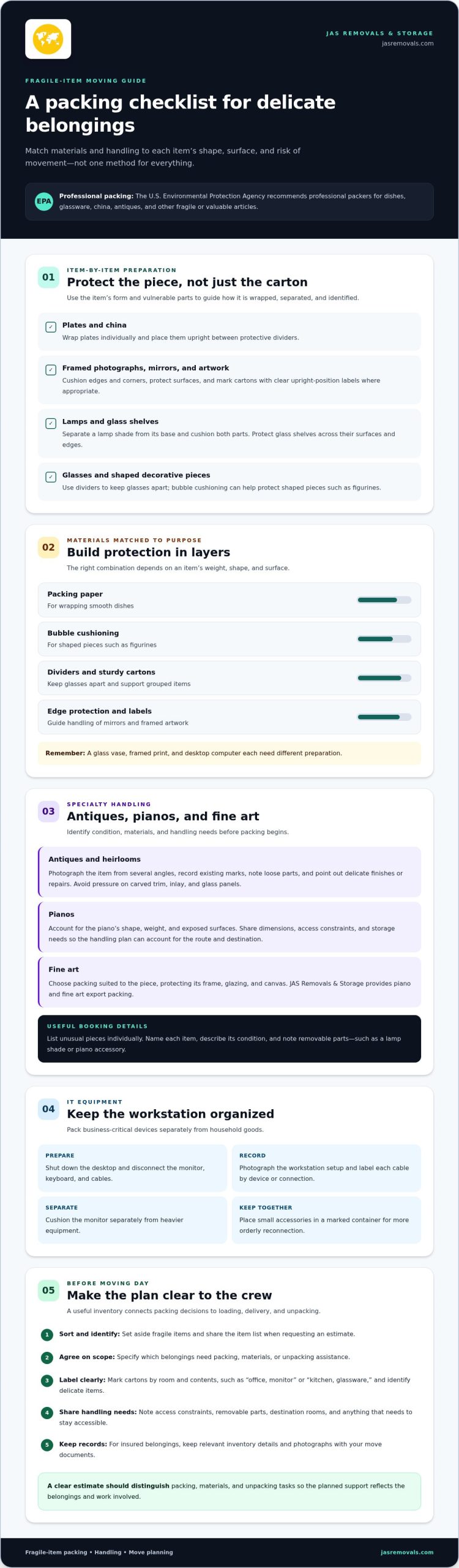
Professional packing matches materials and methods to each item’s shape, surface, and risk of movement. A glass vase, framed print, and desktop computer each need different preparation.
Packing Fragile and Delicate Belongings
Professional packers should handle dishes, glassware, china, antiques, and other fragile or valuable articles, according to the U.S. Environmental Protection Agency. For a plate, that can mean wrapping it individually and placing it upright between protective dividers. A framed photograph needs corner protection and cushioning around its edges.
Look for item-specific preparation in the packing plan. For example, a ceramic lamp’s shade should be separated from its base, with both parts cushioned and clearly identified. Glass shelves need protection across their surfaces and edges. These details help prevent belongings from shifting against one another inside a carton.
Specialty materials serve different purposes. Packing paper can wrap smooth dishes, while bubble cushioning can help protect shaped pieces such as decorative figurines. Dividers keep glasses apart, and sturdy cartons support grouped items. For mirrors or framed artwork, edge protection and clear upright-position labels guide handling. The right combination depends on each item’s weight, shape, and surface.
Business-critical IT devices need a separate packing plan from household goods. Before the move, shut down a desktop computer and disconnect its monitor, keyboard, and cables. Photograph the workstation setup, then label each cable by device or connection. Cushion the monitor separately from heavier equipment, and keep small accessories together in a marked container. This makes unpacking and reconnection more orderly.
First-time movers can reduce confusion by sorting belongings before packing begins. Set aside items that need special attention, such as a glass award, framed certificate, or small china collection. Share the item list when requesting an estimate, and identify anything that needs to stay accessible. A clear inventory gives the packing team practical details for planning materials and carton placement.
Packing and Unpacking Assistance
Packing assistance can cover selected belongings or extend to rooms and household contents. A focused request might include china, framed art, and a desktop setup, while you pack clothing and linens. Agree on which items are included so the estimate reflects the required packing work and materials.
Unpacking assistance can help place belongings in their destination rooms and open cartons to make settling in easier. For example, kitchen cartons can go to the kitchen, while computer equipment stays together near the workstation. Keep essential items identifiable, and tell the team where fragile pieces should go before cartons are opened.
Clear labels connect packing decisions to the move itself. Mark cartons by room and contents, such as “office, monitor” or “kitchen, glassware,” and visibly identify delicate items. This gives handlers useful direction during loading and delivery. A detailed estimate should distinguish packing, materials, and unpacking tasks so the planned support matches the belongings and work involved.
Specialty handling for antiques, pianos, and fine art
Specialty handling starts by identifying each item’s materials, condition, and handling needs. A piano, carved cabinet, and framed painting each require a different plan.
The U.S. Environmental Protection Agency recommends that professional packers handle dishes, glassware, china, antiques, and other fragile or valuable articles. A move plan should also identify who packs each piece, how it will be protected, and where it will travel during loading and delivery.
Care for Antiques and Heirlooms
For an antique clock or inherited cabinet, record existing marks before packing begins. Photograph the item from several angles, note loose parts, and point out delicate finishes or repairs. This creates a clear reference if its condition is questioned after the move. Careful handling also means avoiding pressure on fragile details such as carved trim, inlay, or glass panels.
A piano needs attention to its shape, weight, and exposed surfaces. Fine art needs protection for its frame, glazing, and canvas, with packing suited to the piece. JAS Removals & Storage provides piano and fine art export packing for these specialized belongings. Share dimensions, access constraints, and storage needs during booking so the handling plan accounts for the route and destination.
Handled Items and Exclusions
Common fragile items include glassware, china, lamps, mirrors, framed artwork, antiques, and musical instruments. Fragility alone doesn’t automatically exclude an item. The deciding factors are its size, condition, handling requirements, and whether those needs fit the agreed packing and transport scope. Items requiring a different type of transport need arrangements suited to that requirement.
During booking, list unusual pieces individually rather than grouping them as “valuables.” Name each item, describe its condition, and note removable parts, such as a lamp shade or piano accessory. This gives the crew specific information for planning equipment and access. For insured belongings, keep relevant inventory details and photographs with your move documents.
A shared handling plan helps crews identify each item, prepare protective materials, coordinate lifting, and secure it for transit. For example, a heavy cabinet may need clear access through doorways, while a painting needs space to prevent pressure on its face. These steps reduce hurried decisions on moving day.
If damage appears, photograph the item and its packaging before moving either. Record what happened, retain relevant materials, and report the issue through the mover’s stated process. Keep booking details, the inventory, and coverage information together. These records help explain the item’s condition and the handling involved.
If a piano or artwork needs specialist preparation before a move or storage, consider piano and fine art export packing as part of the handling plan.
Custom crating for fragile and high-value items
A custom crate creates a fitted enclosure for an item that needs extra support during transport. Its design should reflect the object’s shape, weight, vulnerable surfaces, and how it will be moved.
Crating can suit a sculpture with projecting details, a large mirror, or a valuable piece that cannot sit securely in a standard carton. Start by documenting the item’s dimensions and condition. Note fragile edges, removable parts, and areas that should not bear pressure. These details guide the crate’s interior supports and help handlers position it correctly.
A practical crating plan follows the item from preparation to delivery:
- Measure the object and identify delicate surfaces or protruding features.
- Wrap or cushion contact points to separate the item from the crate walls.
- Position internal supports so the object stays stable without pressure on vulnerable areas.
- Mark orientation and handling instructions where they will be visible during loading.
- Keep photographs and an item description with the move inventory.
For example, a framed painting needs clearance around its frame and protection across its face. A sculpture with a narrow base may need support that limits shifting without putting pressure on delicate details. A crate should suit the object’s needs, not merely enclose it. Small differences in shape can affect where cushioning or support is needed.
Reviews can help readers assess how movers handle delicate belongings. Look for specific descriptions, such as a crew protecting a framed artwork, communicating about a heavy cabinet, or placing a crate carefully. Repeated, detailed accounts offer more practical context than a general statement of satisfaction. For searches involving movers in Wilmington, consider whether reviews discuss comparable items and clear handling, rather than relying on location or star ratings alone.
Ask for the crating work to be explained in the estimate. It should identify the item involved, the packing or crate preparation, and whether handling is included. For a local move in Wilmington, the overall estimate may also reflect travel and labor arrangements. An hourly structure concerns time spent; it does not explain by itself what crate materials or item preparation involve. A helpful estimate makes those parts understandable before booking.
Before crating, remove loose accessories only if they can be separated safely, and keep them identified with the item. Tell the crew about existing damage, past repairs, or parts that must remain attached. This gives handlers practical instructions and creates a clearer record of the item’s condition before transport.
Pricing by vehicle size, mileage, and labor time
A moving estimate reflects the work and transport a particular move requires. Vehicle size, mileage, labor time, furniture volume, and fragile-item preparation can all affect the quote. A small move with a few delicate pieces has different logistical needs from a longer journey involving large furniture and specialty handling.
The estimate depends on the move and is provided after a quote request. Vehicle size, mileage, labor time, packing, and crate requirements all contribute. A useful estimate describes the planned work clearly rather than presenting a total without context. Compare what each estimate includes, such as loading, travel, packing materials, and requested preparation for fragile belongings.
Vehicle size depends on the volume of furniture and cartons to transport, along with the items’ dimensions. A large cabinet may take substantial space even when it is a single piece. A piano or crated artwork can also affect how other belongings fit. An accurate inventory helps match the vehicle to the load and avoids planning around incomplete information.
Mileage describes the distance between pickup and delivery, while labor time reflects the work involved. Stairs, a long walk from the entrance, narrow doorways, and elevator access can change loading and unloading effort. For example, moving a glass-fronted cabinet from an upper floor may take more coordination than loading an accessible piece. Share access details when requesting an estimate.
Some moving services use an hourly structure, while others base estimates on different elements of the move. When labor is billed by time, the work scope and access conditions help explain how the hours may add up. Ask for the estimate to distinguish labor from travel and separate packing or crating tasks. That breakdown makes it easier to understand how changes to the inventory could affect the cost.
- List fragile items separately from general furniture, including approximate dimensions.
- Describe stairs, elevators, parking access, and the distance from the entrance to the vehicle.
- Identify whether packing, unpacking, or custom crating is part of the requested work.
- Tell the estimator about added belongings before moving day, not at the loading point.
A flexible plan can help if the inventory changes, but added pieces may affect vehicle space or labor. For instance, adding a large mirror could require different protection and careful placement. Keep a copy of the item list and compare it with the estimate before booking. Clear details reduce stress and support a more useful discussion about moving arrangements.
A provider’s rating can offer context about communication and punctuality, but it doesn’t explain the scope of a specific quote. Read reviews for examples of how crews handled furniture, schedule changes, or fragile belongings. Then assess the estimate itself: clearly described tasks, relevant access details, and a defined transport plan are more helpful than a rating alone.
Damage coverage and service guarantees
Damage coverage describes how a moving company handles a report of loss or damage. The written terms explain what protection applies, how responsibility is assessed, and what information supports a claim. Read those terms before booking, especially when a fragile item’s replacement value matters.
Coverage can depend on the selected protection, the item’s condition, and the circumstances of damage. For example, a cracked glass tabletop may be assessed differently from a carton packed by its owner. Review the coverage document for its valuation method, exclusions, limits, and any deductible. These details clarify what compensation may apply, rather than suggesting every damaged item receives the same outcome.
Distance matters for planning, but it does not replace understanding coverage. A move across the country can involve more handling stages than a short journey, so keep the inventory and coverage records accessible throughout transport. For a painting, record its condition before packing and keep photographs with its description. Clear records help establish what was moved and how it arrived.
Service guarantees and damage coverage address different concerns. A guarantee may describe a specific service commitment, such as completing an agreed task, while damage coverage addresses reported loss or damage under written terms. Neither phrase explains the conditions on its own. Read the wording for the item, service, and move involved, including any steps required to report a problem.
If you discover damage at delivery, follow a steady, documented process:
- Photograph the item and its packaging before moving or discarding anything.
- Record the damage, the item’s location, and the condition of its carton or crate.
- Keep the inventory, estimate, coverage document, and relevant communications together.
- Report the issue through the moving company’s stated process and retain a copy.
Keep original packing supplies until you have inspected fragile belongings. A crushed corner on an artwork carton or broken cushioning around a vase can help explain what happened. Avoid making repairs or discarding damaged parts before documenting them. Follow the written reporting steps and provide concise details, such as the item name, visible damage, and delivery date.
An affordable move still needs clear protection terms. Compare the written coverage and service scope, not just the estimate total. Check how fragile items are recorded, what packing work is included, and which conditions affect a claim. This makes the protection easier to understand before booking, whether the move is short or across the country.
For a move involving fragile belongings, review the coverage terms alongside the packing and transport plan. Request a moving estimate with your item list and move details.
JAS Removals & Storage: International Moves
JAS Removals & Storage can help plan an international move involving fragile household belongings, coordinating around the shipment and destination. Share an item inventory, identify pieces needing special care, and explain whether packing or storage is part of your plans.
For moves within the country, Domestic Moves help coordinate household relocations. Office Moves support business relocations, while Secure Storage can help when delivery timing and access to belongings don’t align. These services are useful when fragile possessions need to move as part of a wider household or workplace transition.
Prepare a clear list of delicate items and the handling questions you want addressed. Contact JAS Removals & Storage to discuss your move, or visit jasremovals.com.
Plan the next move with care
Fragile belongings deserve a place in your moving plan from the outset. Before confirming arrangements, decide which items need individual attention, whether they are part of a household or workplace move, and what details describe their handling needs. This gives you a practical starting point for a conversation with movers for fragile items, especially when valuable pieces are travelling with everyday belongings.
JAS Removals & Storage offers International Moves, Domestic Moves, and Office Moves. Choose the type of move that fits your next transition, then prepare an inventory that identifies delicate items and their destination. A clear starting point helps keep the conversation focused on the route and belongings involved. Contact JAS Removals & Storage to discuss your move and take the next step with a considered plan.
Frequently Asked Questions
What happens if an item gets damaged during my affordable move?
Document any damage promptly, then follow the reporting process in your move paperwork. Photograph the item, its packaging, and the area where it was delivered before moving or repairing anything. Keep the inventory and relevant correspondence together. For example, if a lamp arrives with a cracked base, record the damage and retain any broken pieces. The applicable coverage terms and evidence inform how the report is reviewed.
How do professional movers pack and transport fragile items?
Professional movers assess an item, protect vulnerable surfaces, and secure it for transport. For example, a glass-fronted cabinet needs protection that prevents contact with other furniture and limits movement. The U.S. Environmental Protection Agency recommends that professional packers handle dishes, glassware, china, antiques, and other fragile or valuable articles. Clear labels and an inventory help keep handling instructions connected to each item throughout loading and delivery.
How much does it cost to hire movers for fragile items?
The estimate depends on the move and is provided after a quote request. Vehicle size, mileage, labor time, packing, and crating all affect the estimate. A move with a few boxed glass pieces differs from one involving a piano or artwork requiring custom preparation. Share the item list, pickup and delivery details, access conditions, and requested packing work. These specifics help shape a quote around the work and transport involved.
Do movers offer specialty crating for artwork, antiques, glass, and electronics?
Specialty crating can be designed for items whose shape or surfaces need more support than ordinary cartons provide. Artwork and antiques may need carefully positioned interior supports, while electronics need protection for screens, ports, and detachable components. JAS Removals & Storage offers piano and fine art export packing, including bespoke crating. For other objects, the packing plan should identify their dimensions, fragile points, and any accessories travelling separately.
How should I compare movers for fragile-item packing and handling?
When comparing movers for fragile items, focus on the written scope, not a general promise of careful service. Check whether the estimate identifies which belongings are packed, what preparation is included, and how crating or special handling is described. Also compare how inventories, damage reports, and coverage documents are handled. Using the same item list and access details for each estimate makes differences easier to understand.
What insurance or valuation coverage do movers provide for damaged fragile items?
Coverage depends on the written terms selected for the move, so read the valuation method, exclusions, limits, and reporting steps. The word “insured” alone doesn’t explain how a damaged heirloom or artwork would be assessed. Keep its inventory description and pre-move photographs with your move documents. If damage occurs, submit a clear account with supporting images and preserve the packaging. The documents explain the process and applicable terms.
How do I prepare fragile items before movers arrive?
Start by making an item list that separates fragile belongings from general household goods. Photograph valuable pieces and note visible wear, loose fittings, or detachable parts. Clear the route from each item to the exit, especially around stairs and tight doorways. Keep jewelry, important documents, and small personal essentials apart from packed household contents. For electronics, save connection details and group accessories with their device.
What packing materials and techniques best protect fragile items during a move?
Choose materials according to each item’s surface and shape. Dividers help separate drinking glasses, cushioning protects projecting details, and corner guards shield framed pieces from knocks. A carton should hold its contents securely without forcing delicate objects into place. For a computer monitor, protect the screen and pack cables separately in a labeled pouch. Avoid placing heavy belongings on fragile cartons, even when their outer walls seem sturdy.