

Fragile belongings are better protected when you wrap each item separately and pack it in a sturdy box, with paper cushioning plates, bowls, and cups. Good international move packing advice also includes protecting furniture edges, securing appliance parts, and keeping the essentials you’ll need soon after arrival in luggage you retain.
Careful wrapping matters, but deciding what to take is just as important. A lighter, well-prioritized move means less to pack and makes it easier to keep essential items close at hand.
This guide explains how to protect breakables, assess appliance compatibility, and prepare essentials for your journey. You’ll also learn to prioritize belongings by when you’ll need them and declutter before moving abroad, so every item has a place in your plan.
Key Takeaways
- Wrap breakables individually, cushion them securely, and protect furniture surfaces and edges against transit damage.
- Check appliance manuals and electrical requirements before deciding what to take, and secure movable parts for transport.
- Keep documents, medicines, and items needed soon after arrival with you rather than in an international shipment.
- Sort belongings by when you’ll need them, since household shipments can take weeks to arrive.
- Declutter before packing: taking fewer, more useful belongings can reduce shipment volume and simplify settling in.
1. Furniture, kitchen goods, and sentimental items
Use sturdy boxes for fragile belongings and wrap each piece individually in bubble wrap or packing paper. Place paper between plates, bowls, and cups to cushion them and reduce the risk of chipping during the journey.
Consider carefully which furniture is worth taking. Moving furniture overseas can be difficult, risky, costly, and impractical. Taking apart and reassembling flat-pack pieces can also weaken them. If you do move furniture, cover exposed edges to help prevent chips and use a bedsheet to protect surfaces from scratches. Keep screws and fittings together with the item they belong to, so they’re easy to find when it’s time to reassemble.
Plan kitchen packing by cabinet rather than guessing at the last minute. A suggested estimate is 1.5 moving boxes per kitchen cabinet, plus 2 boxes for countertop appliances. Use extra tape across each box’s bottom to help it stay closed when lifted. Pack plates and bowls vertically, with paper between each piece, and fill gaps so contents can’t shift. Don’t overfill boxes; keep each one manageable to carry.
Prepare large appliances before loading. Unplug a refrigerator 24 hours beforehand so excess water and ice can drain, then defrost and clean refrigerators and freezers in good time to help prevent mold. Secure a microwave’s glass turntable with tape to protect it from movement. Use the bolts supplied with a washer to secure its drum before the move.
Pack books in several small boxes because they’re heavy, rather than filling one large carton. For clothes, a wardrobe may take 8 moving boxes, while hanging garments can be estimated at 1 box per meter. Choose durable shoes and everyday clothing for your luggage, and reserve shipment space for items you’ll use in your new country.
Protect keepsakes individually and give them a clear place in your plan. Wrap framed photographs separately, cushion the corners, and keep small mementos in a labeled, sturdy box. Scan photographs and save digital copies before packing, so you can access them without using shipment space. Keep irreplaceable items separate from everyday household goods instead of burying them under kitchen cartons.
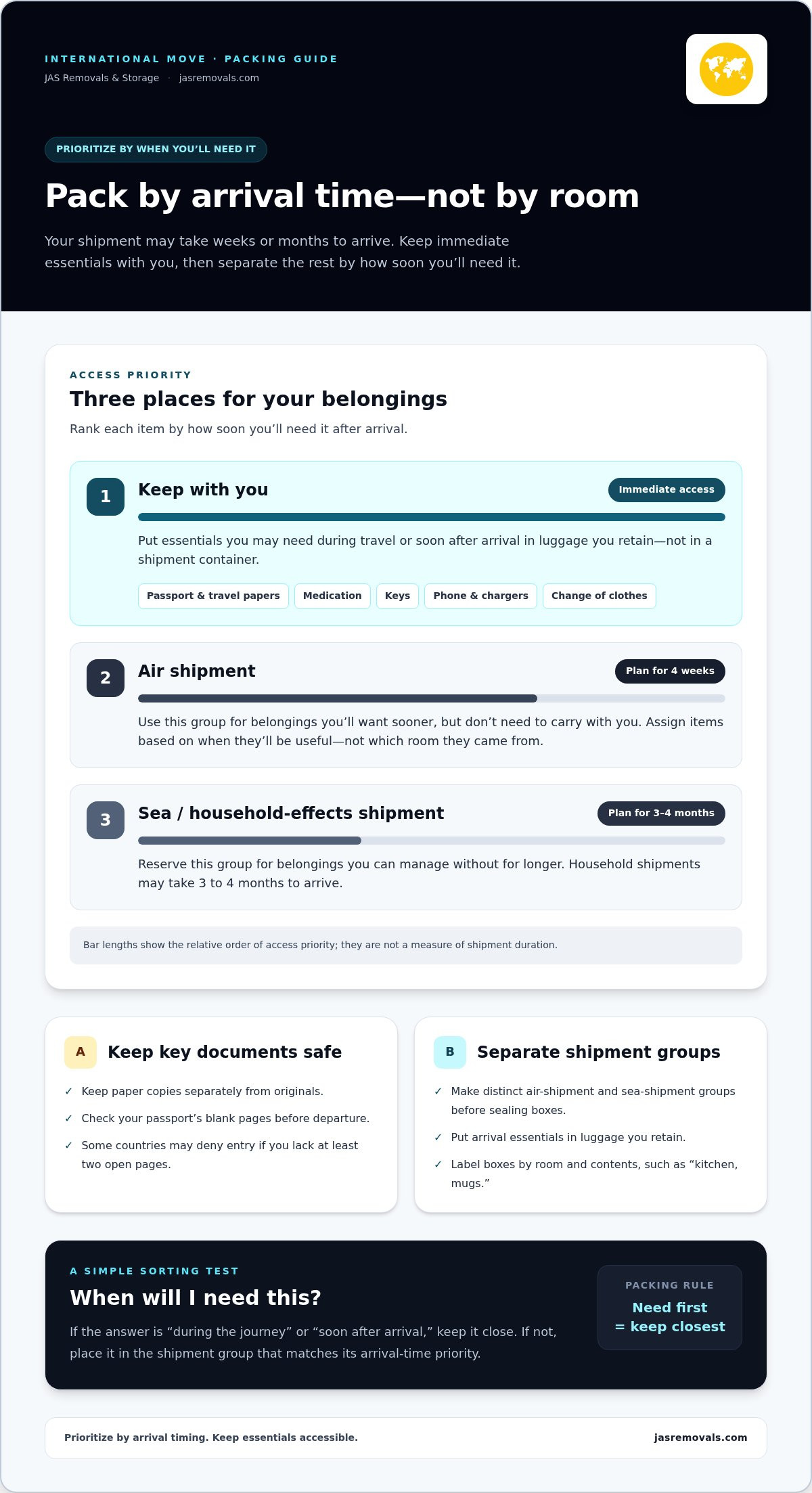
Separate belongings by shipment method before sealing boxes. Make distinct air-shipment and sea-shipment groups, then put items needed soon after arrival in luggage instead. Plan for an air shipment to take four weeks; an international household-effects shipment can take 3 to 4 months. Choose the group for each item according to when you’ll need it, not simply its room of origin.
Keep important items secure and accessible by packing documents, keys, medicines, and a change of clothes in luggage you retain. Label boxes by room and contents, such as “kitchen, mugs,” to make priority items easier to find. Pianos and artwork may need specialist protection, so use suitable piano and fine art export packing rather than treating them like ordinary furniture.
2. Electrical appliances and compatibility
Before packing an appliance, check whether it will work in your destination country. An appliance from home may not be suitable abroad, and some devices may need a plug adaptor. An adaptor changes the plug connection; it does not make an incompatible appliance suitable. Check each device’s label and manual, then decide whether it belongs in your shipment, luggage, or decluttering pile.
Useful international move packing advice starts with a simple inventory. Write down each appliance, its power requirements, and any accessories it needs. Include laptops, phones, kitchen devices, and chargers. Compare that information with the electrical supply used at your destination. An appliance’s voltage rating may affect whether it is suitable for use abroad, so check its requirements before packing.
Pack electronics with their cables and accessories. Put each charger, transformer, and plug adaptor beside the device it serves, then secure loose cables so they don’t tangle or press against screens. Keep small accessories in labeled pouches or boxes. A label such as “laptop charger” is more useful than “cables” when you unpack.
Protect screens carefully. Double-pack electronics with glass screens to reduce the risk of breakage. Wrap the device, then secure it in a second box with cushioning around the sides. Fill empty spaces so the screen cannot shift. Keep tablets and phones you’ll need on arrival in your luggage rather than with household shipment items.
Clothing and shoes can help organize a suitcase, but they shouldn’t be the only protection for electronics. Soft garments may cushion a device, but can shift during handling and leave corners exposed. Pack clothing separately where practical, and protect fragile electronics in a fitted case or wrapping. Keep items you’ll use soon apart from those intended for shipment.
Books need a different approach from electronics. They’re heavy, so divide them among several small boxes instead of filling one large carton. Don’t stack books on a screen or use a hard cover as padding. Pack electronics separately, label both types of boxes clearly, and keep heavy cartons stable to limit shifting during the move.
Appliance manuals can contain special packing instructions, so read them before preparing equipment. Follow the directions for removable parts, cables, and protective packaging, and keep the manual accessible for setup. If an appliance needs a transformer or adaptor, pack it with that item rather than storing it in a miscellaneous box. For support coordinating the wider shipment, review international moving arrangements as part of your packing plan.
3. Carry-on essentials and important documents
Pack documents and immediate essentials in luggage you keep with you, not in a shipment container. Keep your passport, travel papers, medication, keys, phone, chargers, and a change of clothes together. Check your passport’s blank pages before departure: some countries may deny entry if you lack at least two open pages. Store paper copies separately from originals.
Digitize important files before moving, then save copies somewhere you can access without your main luggage. Scan identification, travel documents, medical prescriptions, and essential household records. Use clear file names, such as “passport” or “prescription,” so you can find them quickly after arrival. Keep access details separate, and retain paper copies of documents you may need during travel.
Keep prescription and over-the-counter medicines you can’t do without in your carry-on. Mailing medicines may be difficult or impossible, and destination rules can affect what you may bring. Before packing, research whether essential healthcare products are available where you’re moving. Keep medicines in their original packaging when possible, and carry instructions that help identify each product.
Plan clothing around the destination climate and your first days there. Check the season and expected conditions, then pack practical layers, comfortable shoes, and suitable outerwear in your luggage. For example, a warm coat may be essential on arrival in a cold climate, while lighter clothing may suit a warmer destination. Keep toiletries simple: toothpaste, shampoo, and soap can usually be bought after you settle in.
Review the destination country’s customs fees, import charges, restrictions, and regulations before packing household goods. Countries may restrict certain pets, plants, drugs, and hazardous substances. Packing a restricted item can lead to customs delays and fines. Check the rules that apply to your belongings before putting them in a box or container, and keep any required documents accessible rather than buried in the shipment.
Decide separately whether to take a vehicle. Shipping one overseas can be costly, may involve customs clearance fees, and may be prohibited by the destination country. Research vehicle import rules before arranging transport, and weigh those requirements against your practical need for a car after arrival. Don’t assume a vehicle suitable at home can automatically be imported abroad.
Use these tips to prepare a small arrival kit with documents, medicines, key contacts, chargers, and clothing suited to the destination climate. Keep it separate from belongings packed for air or sea shipment. This matters if a container takes longer to arrive. A written inventory of your carry-on essentials also makes final checks easier before departure.
4. Prioritizing belongings by when they will be needed
Plan your packing order around arrival, not just by room. An air shipment may take six or even eight weeks to arrive, so separate items you need immediately from those that can wait. For example, keep a laptop in your arrival group if you’ll need it for work before your household goods arrive.
Sort household belongings into four practical categories: attire, health care, home items, and personal items. Then mark each “arrival,” “soon after,” or “later.” This makes priorities clear to everyone helping with the move. Keep the “arrival” group to items you’ll use right away, such as work equipment or clothes suited to your destination.
Downsizing makes your priority plan easier to manage. One useful planning model is to start two months before movers arrive. Work through the household room by room, deciding what to take, donate, sell, or discard. A spare chair that won’t fit the new home, for example, may be less useful than space for items you’ll use every day.
Should I use a professional international moving company or pack myself? Professional movers can coordinate an overseas shipment and handle items that need specialist care. You can pack straightforward household belongings yourself if you can protect, label, and inventory them clearly.
How far in advance should I start packing for an international move? Start sorting and downsizing two months before movers arrive, then pack less-used belongings before everyday essentials. This gives you time to make decisions room by room instead of rushing through the whole household.
What insurance covers damage or loss during an international move? Moving transit insurance is the relevant cover to review. Read the wording for covered risks, exclusions, valuation basis, and claim requirements, then keep an inventory and condition records for valuable belongings.
Protect sentimental items by keeping them separate from ordinary household goods. For a family heirloom or framed keepsake, record its condition and pack it where it won’t be confused with everyday items. Keep documents relating to valuable belongings accessible, and don’t put irreplaceable items in a box you may not open for weeks.
Before moving day, label each box with its destination room and timing category, such as “bedroom, later.” Keep a master inventory that matches the labels, and update it when an item moves to another group. This helps you find useful belongings without opening boxes at random after arrival.
5. Decluttering before an international move
Before packing for an overseas move, decide what deserves shipment space and what can be left behind. A useful rule of thumb is to expect you’ll use and need only half of what you think you’ll pack. Apply that test room by room: if an item is rarely used, difficult to replace, or unsuitable for your new home, consider letting it go. Fewer belongings mean fewer decisions to manage while packing and unpacking.
Start with bulky items that take up space but may not be worth transporting. Bed linen, for example, can occupy room in an international shipment, and replacing it after arrival may cost less. Measure large furniture against the layout of your next home, then decide whether each piece will fit and serve a clear purpose. A spare table that won’t fit may be easier to leave behind than to move overseas.
Sort appliances by usefulness, compatibility, and condition. A countertop appliance you use daily may merit space in the shipment, while an old device that rarely leaves the cupboard may not. Set aside items that need further research, such as appliances that may not suit the destination’s electrical supply. This stops uncertain choices from being packed automatically with the rest of the kitchen.
Use four clear categories for each room: take, sell or give away, discard, and decide later. Keep the “decide later” group small, then revisit it before packing begins. For clothing, compare what you wear regularly with what suits the destination’s climate and your likely routine. For books, keep the titles you’ll reread or need rather than packing every shelf just because it’s already there.
Decluttering doesn’t mean treating personal keepsakes as ordinary excess. Choose photographs, letters, and small objects with lasting meaning. Where it helps preserve them without using shipment space, make digital copies of photographs. Give chosen keepsakes a dedicated place in your plan. If an item feels hard to part with, consider whether keeping a photograph or sharing it with family would preserve the memory.
Make decisions early enough to avoid sorting everything on moving day. Starting to downsize two months before movers arrive is a practical way to leave time to review each room. Keep a simple record of what you’re taking and where it belongs. This helps you see whether extra luggage or boxes hold useful belongings or merely items added out of habit.
Moving abroad can be exciting, and a deliberate edit helps make the new home feel considered from the start. Thanks to a room-by-room review, you can focus shipment space on things that fit your next chapter. If you’re planning an overseas relocation, plan your international move with your priorities in view.
JAS Removals & Storage: International Moves
JAS Removals & Storage provides International Moves for households and businesses relocating abroad. Turn to the service when you need help coordinating belongings, shipment priorities, and the overall move plan. If your departure and arrival dates leave a gap, Secure Storage can keep belongings safely stored between stages. JAS also provides Domestic Moves and Office Moves for other relocation needs.
Once you’ve sorted what to take, what to keep accessible, and what can wait, plan how the move will come together. Contact JAS Removals & Storage to discuss your international move.
Take the Next Step Toward Your Move
A useful move plan reflects how you’ll live and work after arrival, not just what can fit into boxes. Set out your priorities, timing, and the support you need, then use that outline to guide your next decisions. Keep the plan practical and flexible as details come together.
JAS Removals & Storage provides International Moves, Domestic Moves, and Office Moves for households and businesses with different relocation needs. If you’re preparing to move abroad, discuss your plans with a team that can help organize the transition. Your international move packing advice can now inform a broader, well-ordered move plan.
Contact JAS Removals & Storage to talk through your move and consider the next steps. A considered plan can help you approach the transition with greater clarity and confidence.
Frequently Asked Questions
How do you protect fragile items?
Protect each fragile object separately, then prevent it from shifting inside its carton. For a ceramic vase, wrap the body and handles individually, support the base, and fill empty spaces in the box with cushioning. Place heavier pieces at the bottom and lighter items above. Mark the carton as fragile and indicate which side should face up, so handlers can see its orientation.
How many boxes do you need?
Estimate box numbers by what you own, then adjust after sorting. A useful guide is about 1.5 boxes per kitchen cabinet and 2 boxes for countertop appliances. Allow 2 boxes per meter of bookcase, and about 8 boxes for a wardrobe. A garage or shed may need 20 to 30 boxes, while garden items may take about 10. These estimates vary with item volume and packing choices.
What about alcohol & food?
Research alcohol and food before packing, because import rules depend on the destination country and the products involved. Check restrictions for household shipments and luggage, including sealed goods, homemade food, and opened bottles. Don’t hide these items among general kitchen contents. If an item’s import status is uncertain, leave it out until you understand the rules, rather than risk shipment delays.
What is the best way to pack your things?
Pack by item type and destination room, and keep a simple record of each box’s contents. Group similar items, protect delicate pieces separately, and avoid mixing immediate essentials with belongings intended for later unpacking. For example, put kitchen utensils in one clearly labeled carton instead of scattering them across several boxes. Keep essential documents and daily-use items in luggage you retain during travel.
What is the most a moving box should weigh?
A moving box should generally weigh no more than 20 kilograms. Keep books and other dense items in smaller cartons, since their weight builds quickly and makes lifting harder. If a box feels awkward to raise safely, remove some contents even if it remains below the limit. Distribute heavy objects across several boxes, and use lighter items to fill remaining space without overloading the carton.
How should I pack fragile items for international shipping?
Choose a sturdy carton that fits the item, with enough room for protective material on every side. Wrap glassware, ceramics, and ornaments individually, then cushion the top and bottom. For a framed photograph, protect the corners and keep it upright between rigid supports. Close the carton securely and label its contents clearly, so it can be identified during handling without opening it.
What items are prohibited or restricted in international moving shipments?
Do not pack hazardous or flammable goods, including cleaning products, matches, and aerosols, for an international move. Destination countries may also restrict certain pets, plants, drugs, and hazardous substances. Check destination import rules before adding unusual or regulated items to a shipment. Keep restricted goods separate while sorting, and don’t assume an item allowed in luggage can also travel in household cargo.
How do I create an inventory and customs declaration for household goods?
Create an inventory that records each box’s number, room, and a clear description of its contents. Be specific, writing “ceramic dinner plates” rather than “kitchen items.” List valuable or delicate belongings individually, and ensure the inventory matches the packed boxes. Use the destination’s required declaration forms and give accurate shipment details so customs officials can understand what the household goods contain.